
Dots and Boxes strategy: chains and extra turns
Learn to spot a third side, follow a forced chain, and understand when giving away boxes can preserve control.
By GoProgs · Examples checked against this implementation. How we check rules.
A fourth side gives another turn
Players alternate drawing one unoccupied line between neighboring dots. Completing a box scores it and gives the same player another move. A line can complete two neighboring boxes at once. When all boxes are claimed, the higher total wins; an equal score is a draw.
The game offers 3×3, 5×5 and 7×7 boxes. The dots are one larger in each dimension: a 3×3 game uses four-by-four dots. Play a computer opponent or take turns with a friend on one device.
Count sides before placing a line
A box with two sides is usually less immediately dangerous than a box with three. Adding a third side can hand your opponent its fourth side, and therefore another move. A line bordering two boxes needs checking on both sides.
Early on, look for lines that do not create an easy capture. Eventually those safe lines run out. At that point, compare the chains you would open rather than choosing the first legal line.
Follow a three-box chain
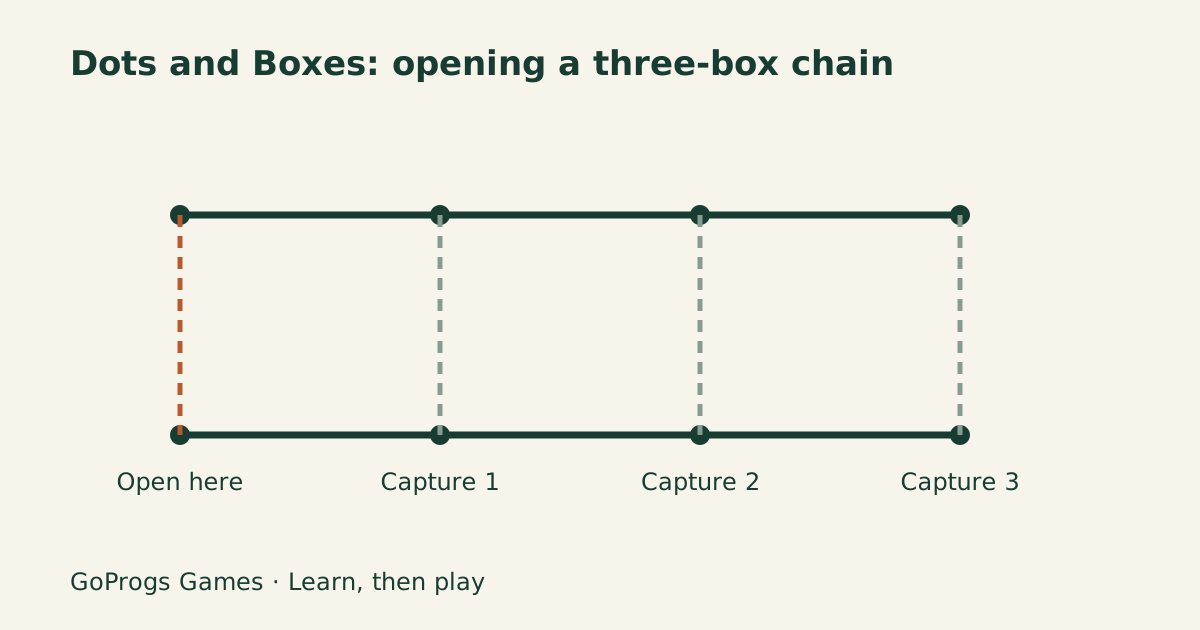
Picture three boxes side by side. Their top and bottom lines are drawn, but both outer vertical boundaries and both internal vertical lines are missing. If you draw the left boundary, box 1 has three sides.
Your opponent draws the first internal line, completes box 1 and keeps the turn. That line also becomes the third side of box 2. They draw the next internal line to take box 2, then the right boundary to take box 3. One opening has given away all three boxes.
The exact boundaries matter: three adjacent boxes do not automatically form a forced chain. Trace which fourth side becomes available at each step.
Why taking every box is not always best
When multiple chains remain, the player controlling the captures may sometimes leave two boxes of an open chain to the opponent, making the opponent open the next chain. This is often called a double-cross. It depends on the rest of the board and is not a reason to give away points blindly.
Loops require different accounting and are not the same as open chains. As a beginner, first learn to identify the full chain, count its boxes and compare the final score if each side takes it.
A useful practice exercise
- Choose a small same-device board.
- Before each line, say which adjacent boxes would gain a third side.
- When a chain opens, follow all the extra turns before changing player.
- Use Undo to compare opening a short chain with a long one.
The whole board matters: opening a shorter chain is a useful starting heuristic, not an optimal-play guarantee. Supported saves stay on this device. For another game where a move can earn an extra turn, read the Kalah guide.