
Mancala Kalah rules: extra turns and captures
Learn Kalah with a six-pit board, a worked extra turn, an exact capture example, and the end-of-game sweep.
By GoProgs · Examples checked against this implementation. How we check rules.
Kalah is one member of the Mancala family
This game implements Kalah: six small pits and one scoring store per player. It is not an Oware ruleset. Choose 3, 4, 5 or 6 starting seeds per small pit, then play a computer opponent or share the same device with a friend.
From South’s view, your pits run left to right and your store is on the right. Sow counter-clockwise. Your opponent’s store is skipped on every lap; your own store receives a seed whenever you pass it.
Sowing and a worked extra turn
Choose a nonempty pit on your side, pick up all its seeds and drop one into each following pit or your own store. The final seed decides whether the turn changes.
With four seeds in each starting pit, choose your third pit from the left. Its four seeds land in your fourth, fifth and sixth pits, then your store. Because the final seed reaches your store, you play again. An extra turn is an opportunity, not a guarantee that this is always the best move.
A capture you can count
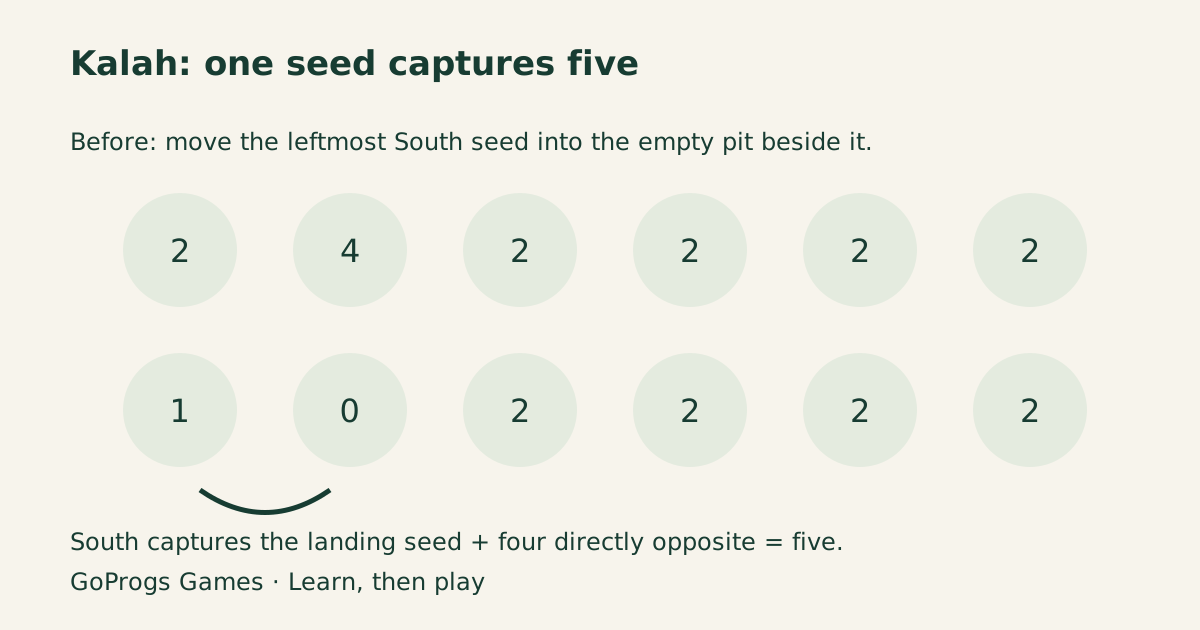
If the last seed lands in an empty small pit on your own side, and the directly opposite pit contains seeds, move both that last seed and all opposite seeds into your store.
For an exact example, let your six pits from left to right be 1, 0, 2, 2, 2, 2. Put four seeds in the opponent pit opposite your second pit. Sowing your first pit drops its single seed into your empty second pit. You capture five seeds: the four opposite seeds plus the one you just sowed.
No capture happens when the final pit is on the other side, was already occupied, or faces an empty pit. Count the landing square before committing; visible seed counts are more reliable than the drawing’s spacing.
When the game ends
The game ends as soon as either player has no seeds in their six small pits. Seeds remaining on the other side are swept into that side’s store. The larger final store wins; equal totals are a draw. A final seed in your store does not grant another move after the ending condition has been met.
The number of seeds is conserved. With four starting seeds in twelve pits, the final stores total forty-eight. A store of twenty-four is half the seeds, not a guaranteed win until the other score is determined.
A practical beginner routine
- Count immediate extra turns and captures.
- Check what your move leaves opposite your opponent’s empty pits.
- Compare both final stores before emptying your side.
- Use Undo to inspect an alternative line, rather than treating one opening as universal.
The page’s controls list keyboard pit selection and animation options. Supported saves stay in this browser; they do not sync to another device. For another turn-based game, try Reversi.