
Spider Solitaire strategy for 1, 2 and 4 suits
Learn how movable runs, empty columns and stock deals work in Spider Solitaire, with beginner plans for each suit count.
By GoProgs · Examples checked against this implementation. How we check rules.
What stays the same across suit counts?
Spider uses two decks, ten tableau columns and eight completed king-to-ace runs. Cards build downward by rank. A single card may move onto a card one rank higher of any suit, but a group moves together only when every card is face up and the descending group is one suit.
An empty column accepts any movable card or same-suit group. A completed same-suit king-to-ace run clears automatically. Complete eight runs to win.
A move can be legal without making a movable group
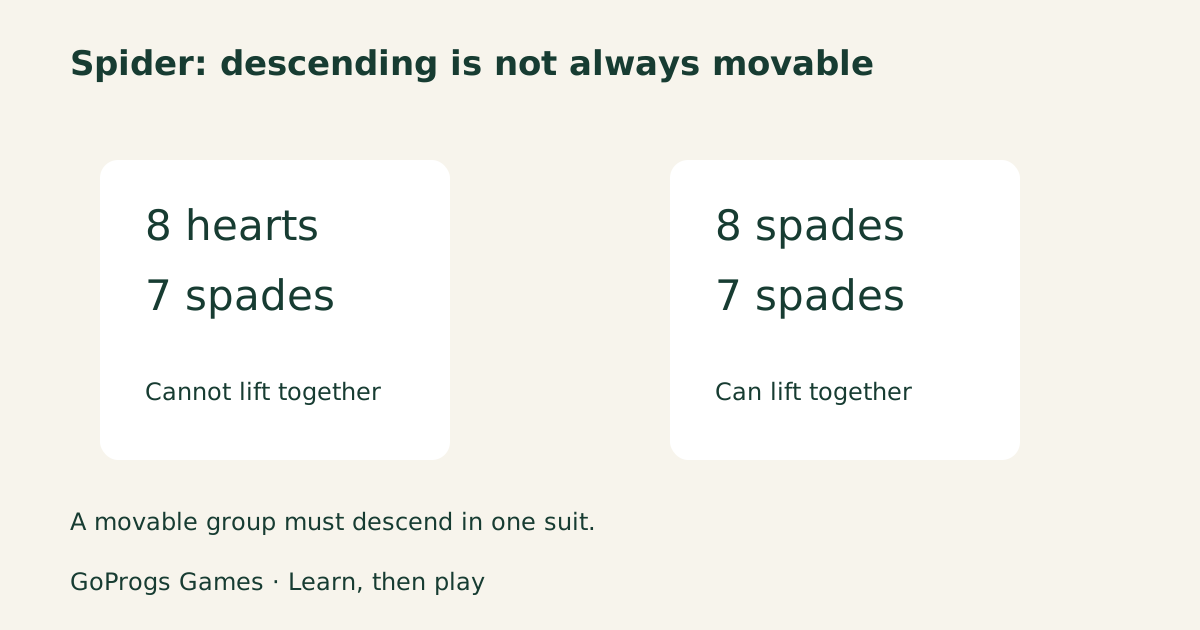
Put a seven of spades on an eight of hearts: that individual move is legal. The resulting eight–seven group is mixed-suit, so it cannot move together. Put the same seven on an eight of spades and the pair can move as one descending same-suit run.
That distinction matters most in two- and four-suit games. Build in suit when practical, but a temporary mixed-suit placement may still be worthwhile if it uncovers a face-down card or frees a column.
Use empty columns as working space
An empty column lets you park part of a sequence while reorganizing another column. Protect that flexibility: filling your only empty column with a long, awkward stack can remove more options than it creates.
For example, with eight of hearts over seven of spades, move the seven to an empty column. The eight can then move separately, potentially exposing a face-down card. Check that you can later rejoin or relocate the parked seven.
Plan before dealing from the stock
Each stock deal adds one face-up card to every column. This implementation requires all ten columns to be nonempty before dealing. Use your temporary space first, then fill any empty columns to make the stock available.
Do not deal automatically whenever you see a legal stock button. Compare useful moves already on the table, particularly those exposing hidden cards. Conversely, repeating moves without uncovering anything does not improve the deal; a stock row may be the next productive action.
A plan for one, two and four suits
- One suit: focus on rank order, exposing face-down cards and keeping a working column.
- Two suits: distinguish a descending stack from a truly movable same-suit run. Favor consolidation when it retains space.
- Four suits: plan short rearrangement sequences before moving. Empty columns become especially valuable because mixed-suit groups fragment more often.
These are heuristics, not a promise that every shuffled deal is solvable. Hint suggests a move; it does not prove a winning continuation.
Use the daily deal for a repeatable challenge or a random deal for practice. A supported save stays in this browser with its current suit count and deal type. For a different solitaire ruleset, try Klondike Solitaire.