
Reversi strategy: corners, mobility and useful moves
Learn legal captures, why corners matter, when to avoid corner-adjacent squares, and why early disc count can mislead.
By GoProgs · Examples checked against this implementation. How we check rules.
Start with legal captures
Reversi uses an eight-by-eight board. Black moves first. A legal placement must enclose at least one continuous line of opposing discs between the new disc and another disc of your own color. Captures can run horizontally, vertically or diagonally, and one move can flip several lines.
For a concrete line example, suppose row 4 contains a white disc on d4 and a black disc on e4, with c4 empty. Black on c4 brackets d4 against e4, so d4 flips. An empty gap between the white and black discs would break that capture.
Why a corner is different
A corner cannot be bracketed from beyond the board, so a disc placed there cannot later be flipped. It can become an anchor for stable edge discs. An edge square by itself is not automatically permanent; an opponent may still capture it along the edge.
Look for a legal corner, but compare the whole position rather than memorizing “always take the most discs.” A move that flips many early discs may give the opponent better access to corners or reduce your later choices.
Be careful next to an empty corner
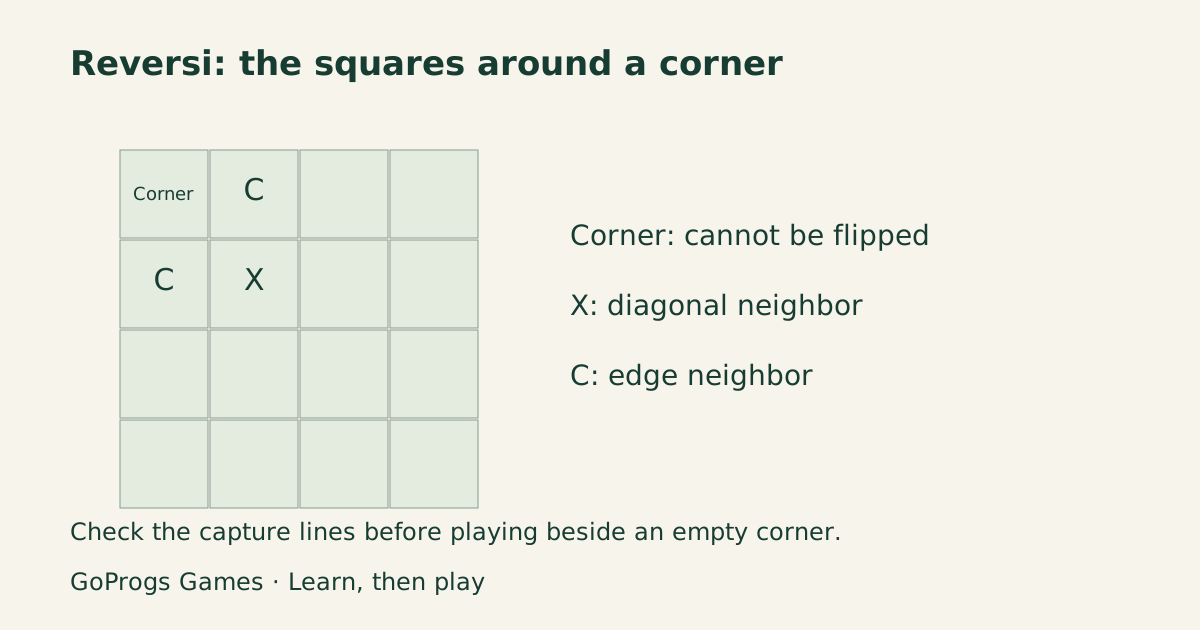
The diagonal neighbor of a corner is commonly called an X-square. The two orthogonal neighbors are C-squares. Playing there can make the corner available to the opponent. It does not always do so: legality depends on the surrounding lines and who owns the relevant discs.
The diagram marks the neighbors of the top-left corner. Before choosing one, trace whether the opponent would then have a legal line ending in your new disc. Once the corner is safely owned, those nearby squares can have a different strategic value.
Mobility matters more than an early lead
Mobility means the number and quality of legal choices available. Give your opponent awkward options while preserving useful moves of your own. Keep an eye on frontier discs, which touch empty squares and may create new capture opportunities.
Disc count decides the final result, but it is a poor sole objective in the opening. Prefer a move that keeps several useful replies over a large flip that leaves you one forced response. In the endgame, exact counting becomes more important because few empty squares remain.
Passes and the finish
If a player has no legal move, that player passes. If neither can move, the game ends even when empty squares remain. The player with more discs wins; equal counts are a draw.
Play a friend on one device to examine both sides, or choose a computer level. Use Undo to compare a corner-adjacent move with a quieter alternative. Supported saves remain in the same browser. For another compact strategy game, try Mancala Kalah.