
How to solve a Nonogram: a worked 5×5 example
Solve a small Nonogram using full lines, overlap and crosses, then use the same steps on larger picture puzzles.
By GoProgs · Examples checked against this implementation. How we check rules.
Read runs, not individual squares
A Nonogram hides a picture behind row and column clues. Each number is the length of a consecutive filled run. Two numbers need at least one empty square between their runs. A clue of 3 in a five-cell line does not say which three cells to fill; it limits the possible placements.
Use filled squares for picture cells and crosses for cells known to be empty. An untouched square is still unknown. In this game, use the Fill and Cross tools; follow the on-page controls for dragging, keyboard navigation and clearing marks.
The complete 5×5 example
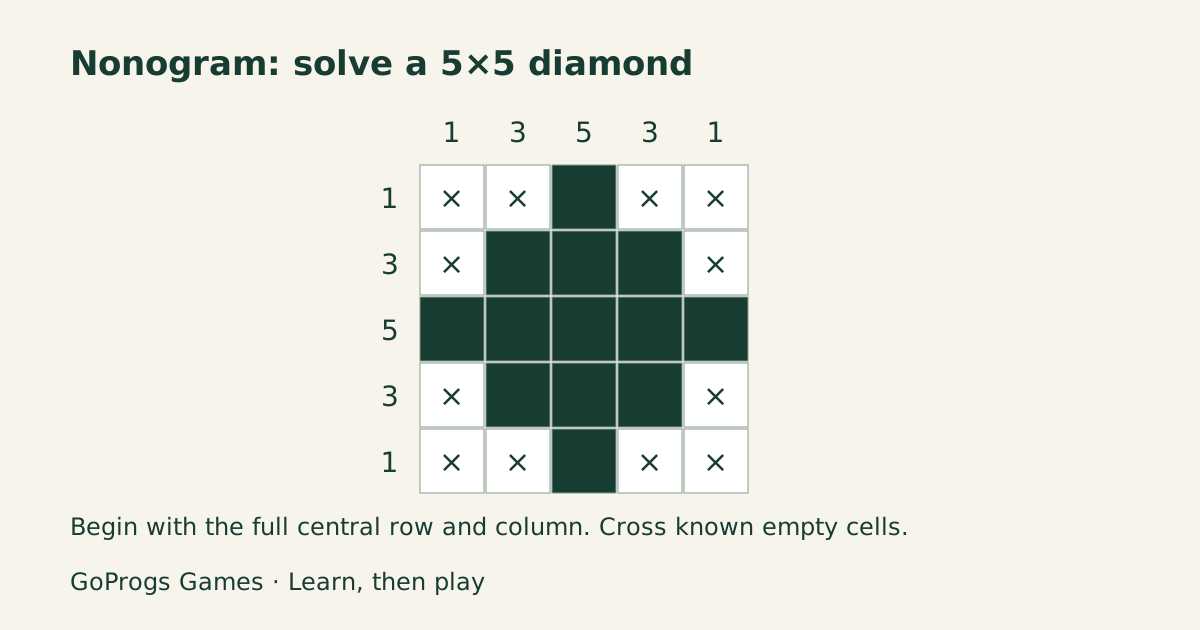
For this tutorial, both the row clues and column clues, in order, are 1, 3, 5, 3, 1. The final diagram shows a diamond. Try reasoning through it before looking at the full picture.
- Row 3 has clue 5, so fill its entire five-cell line.
- Column 3 also has clue 5. Fill it from top to bottom.
- Columns 1 and 5 each have clue 1. Their one filled cell is already in row 3, so cross the remaining cells in those columns.
- Rows 2 and 4 have clue 3. Their outer cells are crossed, leaving exactly columns 2, 3 and 4 to fill.
- Rows 1 and 5 have clue 1. Their central cell is filled already, so cross every other cell in those rows.
The rows now contain 1, 3, 5, 3 and 1 filled cells. Check the column clues as well; a picture that satisfies only the rows is unfinished.
Overlap finds cells before a line is complete
In a five-cell line with clue 3, the possible filled positions are 1–3, 2–4 or 3–5. Position 3 belongs to all three placements, so it must be filled. Positions 1, 2, 4 and 5 are still undecided.
For multiple runs, account for their separating crosses. A clue of 2, 2 in five cells leaves exactly one arrangement: two fills, a cross, then two fills. A clue of 1, 1 has more room and cannot be treated the same way.
Avoid the common mistakes
Do not merge two clue numbers into one long run. Do not fill a plausible picture by guessing its shape. And do not assume a line is complete just because its number of fills equals the total clue count; the lengths and order of runs must match.
Alternate rows and columns after every deduction. When stuck, revisit the fullest lines, look for overlap, and mark confirmed empty cells. Optional mistake checking can help learning; assisted results do not qualify for an unassisted best time.
Try the same method in the game
Choose a 5×5 puzzle first, then move to 10×10 or 15×15 when run spacing feels comfortable. The daily puzzle is a shared 10×10 challenge. Your supported puzzle saves remain on this device and do not require an account.
The tutorial’s fixed diamond illustrates the rules; the game generates its own puzzles. For a different number puzzle, try Sudoku.